


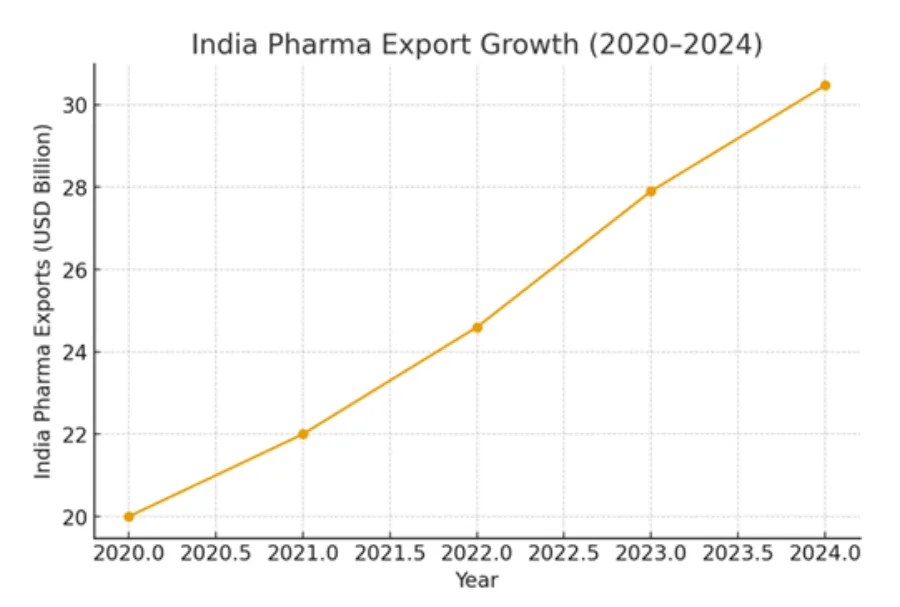
 India Pharma Export Growth (2020–2025)
A simple line graph tracing India’s pharma export value over five years: rising from around USD 20 billion in 2020 to over USD 30 billion in 2025. The chart shows steady year-on-year growth, underscoring the resilience and rising global demand for Indian-made medications.
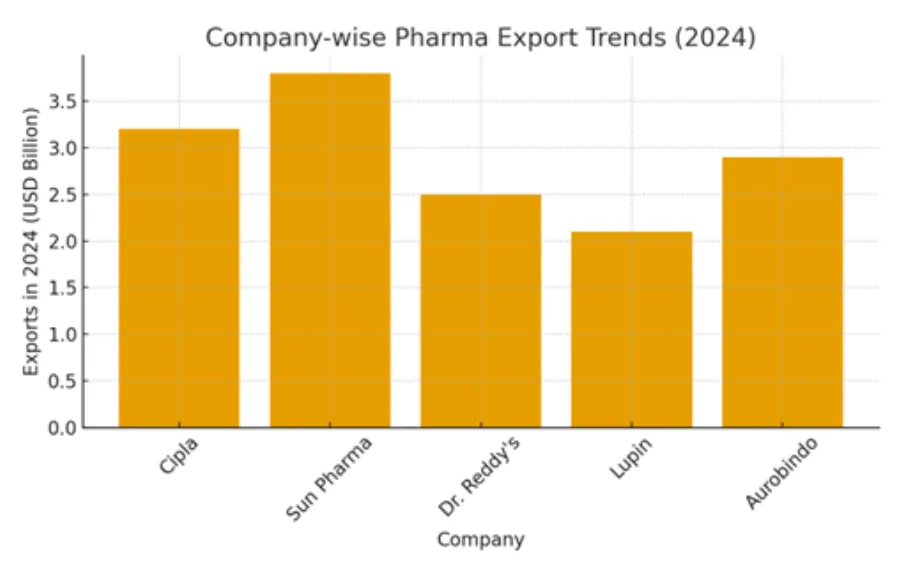 Company-Wise Export Trends (2024)
A bar chart showing estimated export-oriented revenue (or export exposure) for leading companies: Sun Pharma, Cipla, Dr. Reddy’s, Aurobindo, Lupin. Sun Pharma leads, followed by Aurobindo, Cipla, Dr. Reddy’s, and Lupin, illustrating who is most export-driven among major Indian players. (Note: exact USD export values are not publicly disclosed, so this is a proxy based on international / emerging markets revenue.)
Strategic Challenges on the Road Ahead
Expanding into emerging markets is not risk-free. Here are the key hurdles Indian pharma firms must navigate:
- Regulatory fragmentation
Different countries demand different dossier formats; some insist on local clinical bridging, while others need WHO-GMP certificates, varying labeling, and local regulatory agents. - Price sensitivity & tender dynamics
In countries reliant on public procurement (especially in Africa and LAC), margins can be razor thin. Winning volume often means playing the tender game, not just competing on price, but on credit terms, delivery, and relationships. - Supply-chain complexity
Reaching remote areas requires robust distribution. Temperature-sensitive products (biologics, vaccines) demand reliable cold chains. Plus, partner management and serialization add layers of cost. - Quality perception & compliance risk
Indian companies have faced regulatory scrutiny. For example, over 36% of inspected manufacturing units were shuttered due to non-compliance, according to the Indian regulator. Quality lapses can jeopardize credibility in emerging markets. - Currency and macro risk
Dealing with FX volatility, import duties, and non-tariff barriers can erode profitability. And in politically unstable regions, policy shifts can drastically change demand dynamics.
GTM Strategy: A Framework for Emerging Markets
 Here’s a refined go-to-market (GTM) playbook Indian pharma companies can use to succeed in emerging geographies:
- Prioritization & Market Scoring
- Score markets on regulatory ease, demand potential, competitive intensity, and profitability.
- Use a 2×2 framework: Ease of Entry vs Market Potential. Start with one “quick win” market + one long-term bet.
- Regulatory Roadmap & Submissions
- Map out dossier requirements, local licensing needs, and PV (pharmacovigilance) obligations.
- Decide between full filing, reliance/abridged route, or working with a local MAH (Marketing Authorization Holder).
- Partner Strategy & Distribution
- Choose between distributor vs JV vs in-country affiliate.
- For public-procurement-heavy markets, build a dedicated tender team.
- Negotiate favorable credit terms, exclusivity, and responsibilities with partners.
- Supply Chain & Local Manufacturing
- Consider toll manufacturing, fill-finish locally to mitigate import duties and strengthen local presence.
- Build logistic infrastructure: warehousing, serialization, cold chain.
- Pricing, Market Access & Reimbursement
- Develop a robust commercial argument (cost + outcomes) for governments or insurers.
- Prepare local pricing dossiers, tender bids, or value-based proposals where relevant.
- Launch & Commercial Execution
- Hire a local sales force + medical affairs.
- Engage KOLs (Key Opinion Leaders), run educational programs.
- Localize marketing: translate materials, adapt to local clinical practices.
- Governance & Compliance
- Set up local PV systems to handle adverse event reporting.
- Define SOPs for complaints, recalls, and quality audits.
- Performance & KPIs
- Track: registration timelines, partner activation, first shipment, tender wins, margin trends, AE reporting metrics.
- Use dashboards with weekly operational, monthly commercial, and quarterly strategic reviews.

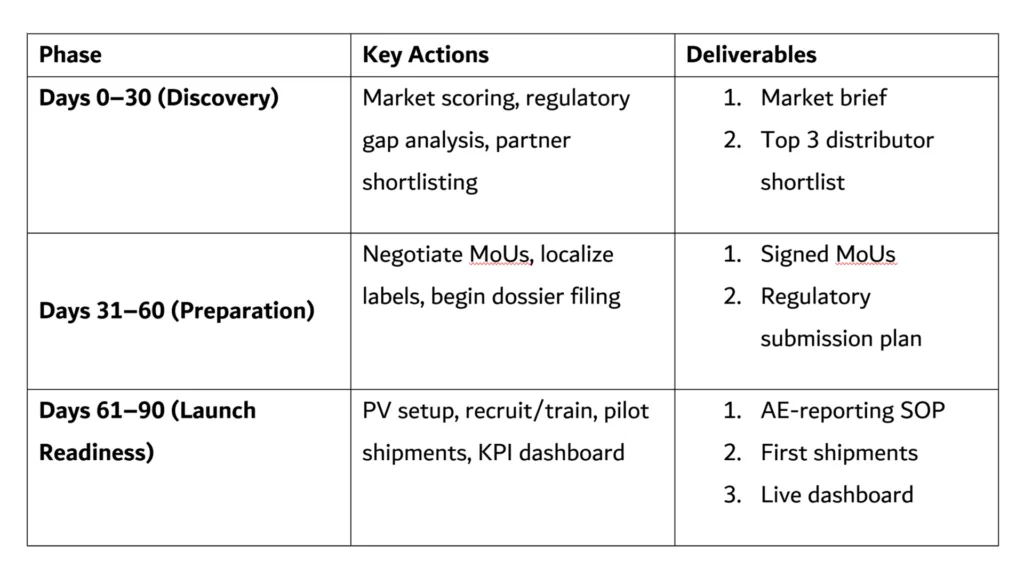
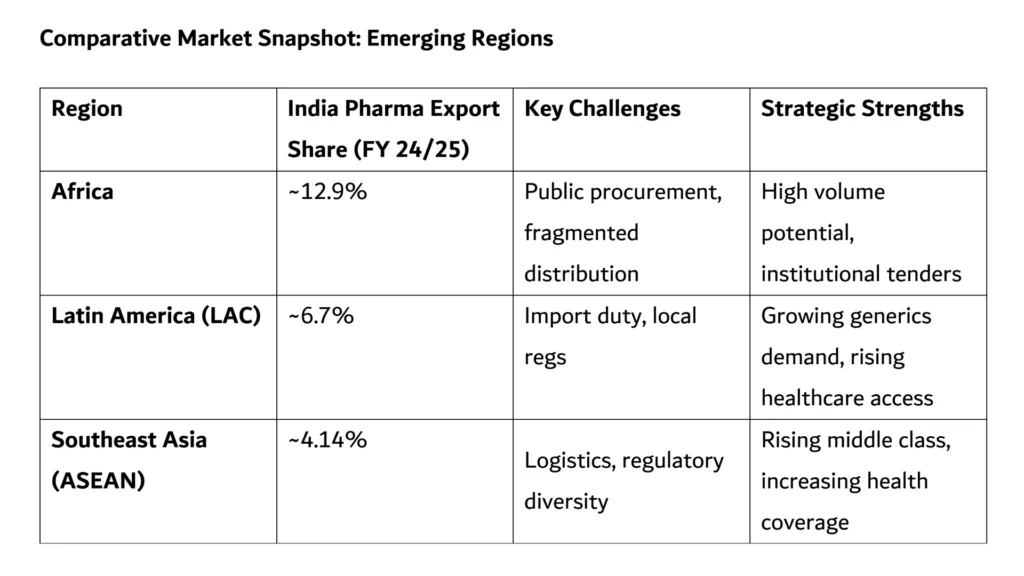
Why This Approach Matters, And How You Can Help Companies Win
 The global pharma landscape is being reshaped by shifting demand centers. For Indian companies, emerging markets are not just alternative export destinations, they are strategic battlegrounds where differentiation, cost leadership, and local partnerships can combine to unlock exponential growth.
Conclusion
India has long been called the “pharmacy of the world,” but the next chapter is being written in places like Lagos, São Paulo, and Jakarta. The surge of demand, coupled with India’s manufacturing prowess, presents a generational opportunity, not just to sell more, but to build lasting partnerships, deepen global trust, and deliver affordable medicines where they are needed most.
As Indian pharma companies plot their next moves, those who merge thoughtful GTM planning with operational excellence will not only boost their bottom lines, they’ll fortify India’s reputation as a global healthcare backbone.
Citations