
The Great Re-Alignment: Why “Value” Is the New North Star
 For too long, the project management discipline operated in a technical vacuum. We became masters of the Gantt chart and the variance report, but we often struggled to answer the C-suite’s most basic question: Why does this project matter to the future of our business?
As the legendary management thinker Peter F. Drucker taught us, “There is only one valid definition of business purpose: to create a customer.” If a project, which consumes time, talent, and capital does not directly contribute to creating, keeping, or deepening the relationship with a customer, or enable the organization to do so more efficiently, it is fundamentally a distraction.
This re-alignment is driven by three measurable forces:
1. The Volatility Tax on Outputs
 In the age of rapid technological change and market disruption, the specific output defined at the start of a project is often obsolete or irrelevant by the time of delivery. A major U.S. retailer, for instance, spent eighteen months building a state-of-the-art inventory management system (a perfect output). However, during that same period, Amazon redefined the logistics standard with two-day shipping. The retailer’s new system, while technically perfect, offered no competitive advantage; it failed to deliver the necessary outcome of speed and agility. They paid a “volatility tax” because they optimized for completion instead of continuous value discovery.
2. Strategic Disconnect and Resource Drain
 Research consistently shows a stark disconnect between strategic goals and project portfolios. According to the Project Management Institute (PMI) and other HBR-quality reports, poor project-strategy alignment is a primary cause of portfolio failure. When projects are viewed as mere outputs, they become siloed operations focused solely on internal targets (95% on-time delivery), rather than external, strategic outcomes (15% market share growth). This disconnect drains vital resources from the initiatives that truly matter. The shift to a value mindset forces an essential question at every phase: Does this next step increase the potential for strategic outcome?
3. The Human Engine of Innovation
 Focusing on value radically improves employee engagement and innovation. People don’t commit their best work to check a box; they commit to a meaningful purpose. When a project team for a major software company was re-oriented from “deliver the next feature release” (output) to “reduce customer churn by 10% through a more intuitive interface” (value/outcome), their performance soared. They had the freedom to innovate beyond the initial scope, leveraging an Agile mindset to rapidly pivot and experiment until the measurable value goal was hit. This balance of rigor and human-centered purpose is the cornerstone of high-performing organizations.
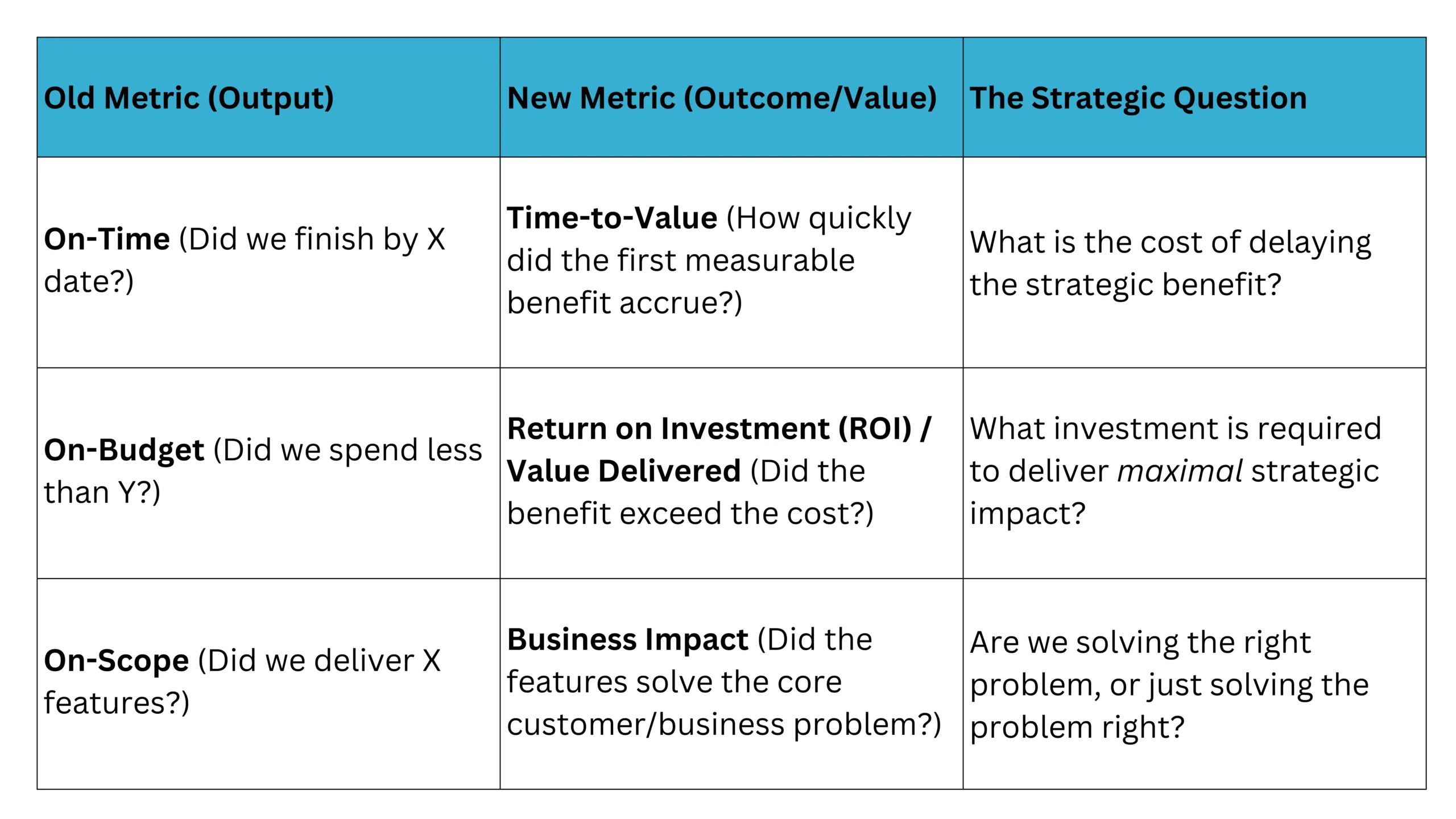
1. Re-Anchor the Definition of Success (Measure the Outcome)
The first step is moving from the “Triple Constraint” (Scope, Time, Cost) to the “Value Equation” (Value, Alignment, Agility).
This is a leadership challenge. If the executive sponsor of the Gabapentin project had stopped funding the moment the initial schedule was missed, the company would have gone bankrupt. The true leader’s decision was to recognize the high strategic potential and pivot the goal from “on-time delivery” to “optimal, scalable, and profitable product launch.”
2. Institutionalize the “Value Hypothesis”
Inspired by the principles of Blue Ocean Strategy, you must make your projects less about execution and more about testing a central Value Hypothesis. Every major project should start with a clear, testable statement:
“We believe that by implementing [Project Deliverable], we will achieve [Measurable Outcome] for [Target Stakeholder/Customer], which will result in [Strategic Business Benefit, e.g., 15% market share increase].”
This forces teams to validate assumptions early and often, treating the original plan as a guide, not a sacred contract. If the hypothesis proves false (the original scope won’t deliver the value), the project must be pivoted or terminated, regardless of how much time or money has been spent.
- Empower the Value Guardians
Empower Project Leaders (your Value Architects) to become strategic partners to the business, not just administrative assistants. This requires a shift in required skills:
- Financial Acumen: Understanding NPV (Net Present Value) and TCO (Total Cost of Ownership) is as important as earned value management.
- Customer Empathy: The ability to speak the language of the customer and the P&L owner.
- Expand Scope: Expand the tertiary of project manager from new product delivery to launch and until it touch the customer’s life.
- Decision Authority: The right to challenge strategic fit and recommend killing a project that is strategically failing, even if it is tactically succeeding.
This moves the project manager from a process administrator to a strategic gatekeeper, a role critical to organizational transformation and superior performance.
Key Takeaways
- The New Definition: Project management is fundamentally shifting from delivering a predetermined output (time, cost, scope) to creating measurable value and strategic outcome.
- The Core Conflict: Many projects are tactical successes (on-time/on-budget) but strategic failures (they deliver no real business value). The Value Architect prioritizes the latter.
- Re-Anchor Success: Move from the Triple Constraint to the Value Equation, where metrics are Time-to-Value, ROI, and Strategic Business Impact.
- Value Hypothesis: Every project must start with a testable Value Hypothesis linking the proposed work to a clear, measurable strategic business benefit.
- Empower the Architect: Equip project leaders with financial acumen and the decision authority to pivot or terminate projects that fail the strategic value test.
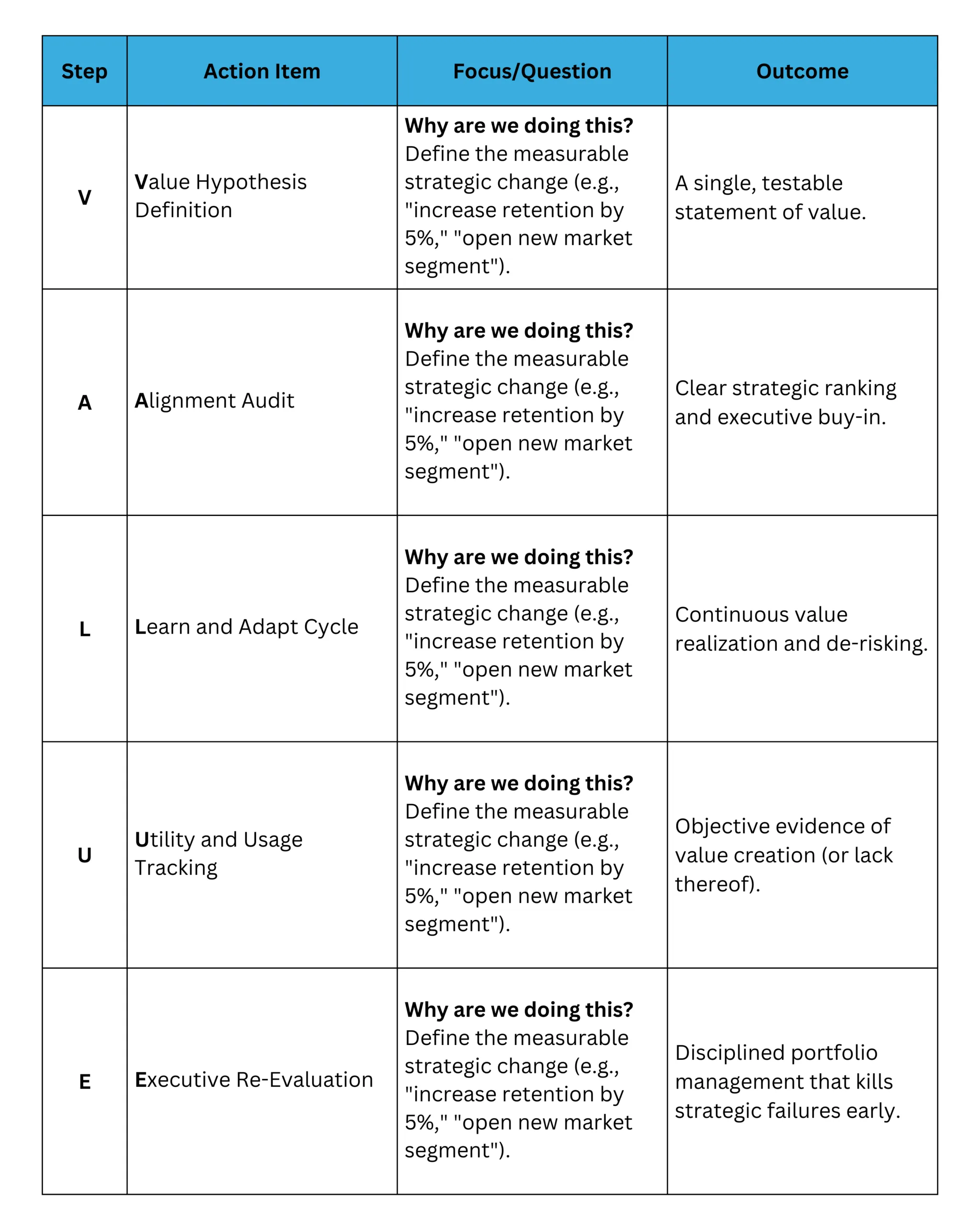
The Value-Driven Project Blueprint: A 5-Step Framework
To help you immediately apply these principles, I offer the V.A.L.U.E. Blueprint; a concise framework for strategic project alignment that ensures every initiative is tied to the ultimate purpose of the business.